
zkVerify for Scalable Proof-of-Humanity Verification in Web3 Identity Protocols

In the fractured landscape of online identity, where bots and sybil attacks erode trust, Web3 protocols demand robust proof-of-humanity mechanisms. Traditional systems falter under scalability pressures, but zkVerify’s recent mainnet launch changes the equation. This dedicated Layer 1 blockchain specializes in zk proof verification scalability, slashing costs and enabling seamless zero knowledge identity protocols across chains. Developers now verify proofs from diverse systems without bloating settlement layers, a cautious yet promising step toward privacy-preserving authentication.

zkVerify positions itself as the universal proof layer, verifying any ZK proof at scale with ultra-fast speeds under one second. By decoupling verification from execution and settlement, it addresses the economic bottlenecks that have long plagued ZK adoption. This isn’t hype; it’s infrastructure built for the long haul, supporting zk credentials verification in decentralized ecosystems.
zkVerify Mainnet: Core Innovations for Cross-Chain Verification
The mainnet rollout introduces native verifiers for major proof systems like Groth16, UltraPlonk, RiscZero, ultrahonk, Space and Time, and SP1. Developers gain flexibility to select optimal methods per application, from high-throughput identity checks to complex computations. Cross-chain attestation contracts bridge ecosystems, allowing proofs generated anywhere to settle efficiently on zkVerify. Integration docs at docs. zkverify. io streamline onboarding, but adoption hinges on real-world stress tests.
This modular approach echoes partnerships like those with Arbitrum and Nexus. xyz, emphasizing verifiable computation without tradeoffs. Horizen Labs’ whitepaper draft underscores lowered verification costs, extending ZK utility to proof of humanity Web3 apps. Yet, while promising, network security and sequencer decentralization warrant vigilant monitoring.
Tackling Scalability Bottlenecks in ZK Ecosystems
ZK proofs compress offchain data into validity attestations, but on-chain verification devours gas and blockspace. zkVerify flips this script, processing verifications off settlement layers for fractions of the cost. Sources like Delphi Digital highlight how this enables millions of proofs, as seen in zkVerify’s 2025 review from testnet to production scale. UltraPlonk and similar curves optimize for speed, but compatibility across systems remains a nuanced challenge.
Comparison of zkVerify Supported Proof Systems
| Proof System | Key Features | Est. Verification Gas Cost | Verification Speed |
|---|---|---|---|
| Groth16 | Fastest trusted setup | 25,000 gas | <1 ms 🚀 |
| UltraPlonk | Universal setup | 100,000 gas | 5 ms |
| RiscZero | RISC-V zkVM | 150,000 gas | 10 ms |
| ultrahonk | Aggregation-friendly | 80,000 gas | 3 ms ⚡ |
| Space and Time | Data proofs | 120,000 gas | 8 ms |
| SP1 | Native apps zkVM | 200,000 gas | 15 ms |
Cross-chain usability upgrades strengthen participation, vital for identity protocols spanning Ethereum, Solana, and beyond. ZKProof Standards’ verified verifiers initiative aligns here, formalizing proof correctness. Cautiously, while costs drop, reliance on specialized L1s introduces centralization risks if node diversity lags.
Proof-of-Humanity Verification: zkVerify’s Web3 Edge
zkVerify proof of humanity shines in building sybil-resistant systems. Cryptographic uniqueness proofs replace flawed biometrics or social graphs, powering zkLogin and similar flows. Online identity is broken, as zkVerify notes, but decentralized verification restores control. Developers craft apps verifying human uniqueness without data leaks, from airdrop protections to governance voting.
Delphi memos flag digital identity markets, where modular ZKP shifts prevail. Chainlens discussions reveal zkVerify’s role in privacy, scalability, verifiability trifecta. Partnerships explore cutting-edge techniques, yet true scale demands millions of daily verifications. This infrastructure lays groundwork, but protocol maturity will prove its mettle amid evolving threats.
Web3 Innovators podcasts detail transformations, with zkVerify as verification linchpin. Upgrades enhance on-chain participation, preparing for mass adoption. Opinion: Patience rewards here; speculative fervor ignores verification’s foundational grind.
Real-world deployments underscore zkVerify’s potential in zero knowledge identity protocols. Imagine governance DAOs verifying voter humanity at scale, or NFT drops shielding against bots, all powered by sub-second proofs. Nexus. xyz collaborations push verifiable computation boundaries, while Arbitrum integrations signal modular verification’s rise. These aren’t isolated wins; they form a cautious blueprint for zk proof verification scalability in production environments.
Developer Tooling and Integration Pathways
Comprehensive docs at docs. zkverify. io demystify onboarding, offering SDKs for Ethereum, Cosmos, and beyond. Native verifiers handle diverse curves, from Groth16’s trusted setups to SP1’s app-native flows. This universality appeals to builders crafting zk credentials verification layers. Yet, integration friction persists; SDK maturity and EVM compatibility will dictate uptake velocity. Horizen Labs’ whitepaper drafts hint at aggregation protocols slashing multi-proof costs further, a pragmatic evolution.
Worldcoin Technical Analysis Chart
Analysis by Market Analyst | Symbol: BINANCE:WLDUSDT | Interval: 1D | Drawings: 6
Technical Analysis Summary
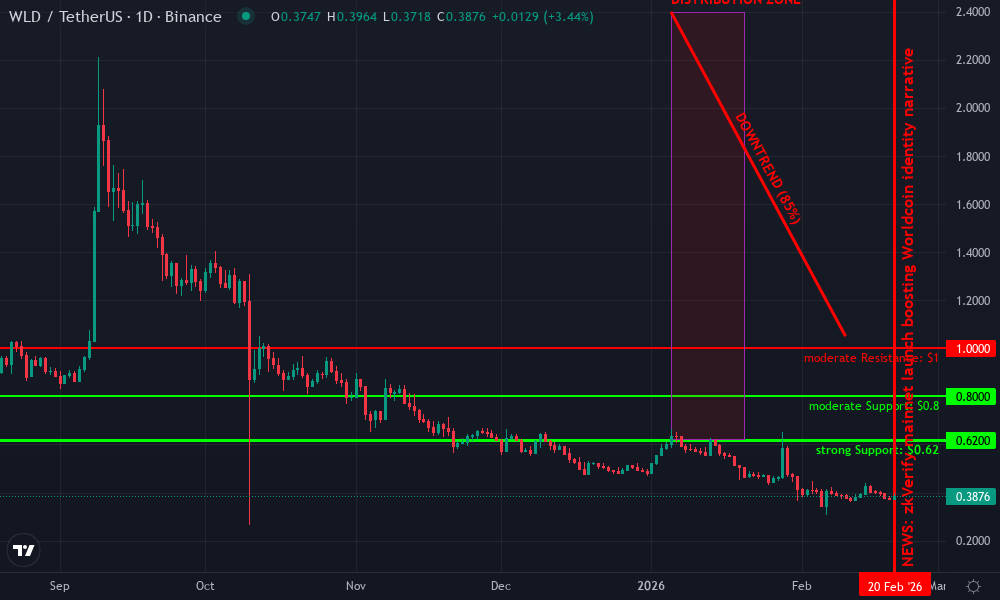
As a balanced technical analyst with 5 years experience, start by drawing a prominent downtrend line connecting the peak at 2026-01-05 around 2.40 USDT to the recent swing high at 2026-02-10 near 1.05 USDT using the trend_line tool, with 0.85 confidence. Add horizontal_lines at key support 0.62 USDT (strong) and resistance 1.00 USDT (moderate). Mark the recent consolidation zone with a rectangle from 2026-02-01 (0.75 USDT) to 2026-02-20 (1.00 USDT). Place fib_retracement from the major low 0.62 USDT to high 2.40 USDT to highlight 38.2% retracement around 1.20 USDT as potential target. Use arrow_mark_up on MACD for bullish divergence signal near 2026-02-15. Add vertical_line at 2026-02-20 for zkVerify mainnet news. Callout low volume on recent uptick. Suggest long entry zone at 0.88 USDT with stop below 0.75 and target 1.15.
Risk Assessment: medium
Analysis: Bearish structure intact but reversal signals emerging with supportive news; choppy action adds uncertainty
Market Analyst’s Recommendation: Consider small long positions on confirmation above 1.00 USDT, scale out at targets, align with medium risk tolerance
Key Support & Resistance Levels
📈 Support Levels:
-
$0.62 – Strong multi-touch low from mid-January capitulation
strong -
$0.8 – Recent swing lows holding as secondary support
moderate
📉 Resistance Levels:
-
$1 – Psychological level and recent rejection zone
moderate -
$1.2 – 38.2% Fib retracement from major drop
weak
Trading Zones (medium risk tolerance)
🎯 Entry Zones:
-
$0.88 – Bounce from 0.80 support amid low volume and positive zkVerify news
medium risk
🚪 Exit Zones:
-
$1.15 – Near-term target at prior swing high extension
💰 profit target -
$0.75 – Below recent lows to protect against breakdown
🛡️ stop loss
Technical Indicators Analysis
📊 Volume Analysis:
Pattern: decreasing on downside, low on recovery
Volume climax on January drop, now drying up suggesting exhaustion and potential reversal
📈 MACD Analysis:
Signal: bullish divergence
MACD line higher low while price tests lows, histogram contracting
Applied TradingView Drawing Utilities
This chart analysis utilizes the following professional drawing tools:
Disclaimer: This technical analysis by Market Analyst is for educational purposes only and should not be considered as financial advice.
Trading involves risk, and you should always do your own research before making investment decisions.
Past performance does not guarantee future results. The analysis reflects the author’s personal methodology and risk tolerance (medium).
2025’s year-in-review charts millions of proofs from testnet to mainnet, validating infrastructure claims. Partnerships with Chainlens and Web3 Innovators amplify visibility, but execution trumps evangelism. Cautiously optimistic: zkVerify sidesteps overpromising by focusing on verifiable primitives over flashy UIs.
Navigating Risks in Proof-of-Humanity Scaling
No silver bullet exists for proof of humanity Web3. Sybil resistance demands ongoing innovation amid adaptive attacks. zkVerify mitigates via cryptographic rigor, but oracle dependencies or verifier bugs loom as vectors. ZKProof Standards’ verified verifiers group formalizes correctness, aligning with zkVerify’s ethos. Economic models must incentivize node operators long-term; sequencer centralization could undermine decentralization purity.
Delphi Digital memos spotlight markets like zkLogin, where digital identity converges with modular ZKPs. Scalability hinges on cost curves bending toward zero, freeing blockspace for innovation. Opinion: Blue-chip potential emerges if zkVerify endures volatility, much like stalwart dividend payers weathering cycles through disciplined fundamentals.
| Proof System | Use Case in Identity | Scalability Benefit | Risk Factor |
|---|---|---|---|
| Groth16 | Fast uniqueness proofs | Low gas trusted setup | Setup ceremony trust |
| UltraPlonk | Universal credentials | Flexible circuit sizes | Higher compute initial |
| RiscZero | RISC-V computations | Guest program ease | Prover centralization |
| SP1 | Native app verification | Hyper-efficient | Ecosystem nascent |
Cross-chain attestation contracts extend reach, but latency arbitrage across L1s requires monitoring. zkVerify’s L1 specialization trades generality for efficiency, a calculated bet in fragmented blockchains. As 2026 unfolds, mainnet stress tests will reveal resilience, with upgrades fortifying against quantum whispers or economic shocks.
Patience defines winners in infrastructure races. zkVerify forges ahead, equipping Web3 with scalable humanity proofs that prioritize privacy and verifiability. Developers eyeing sybil-proof systems find a reliable layer here, provided they temper enthusiasm with rigorous audits. This universal proof engine, honed through partnerships and standards, quietly reshapes identity’s fractured terrain toward sustainable trust.