
Why ZK rollups lead 2026 scaling
By 2026, ZK rollups have moved from experimental prototypes to the dominant scaling narrative for Ethereum. Unlike optimistic rollups, which assume transactions are valid and rely on a seven-day challenge window to detect fraud, ZK rollups prove validity upfront using cryptographic proofs. This fundamental difference changes the user experience from "wait and hope" to "verify and trust."
The primary advantage is immediate finality. When a ZK rollup submits a validity proof to Ethereum mainnet, the network verifies it almost instantly. There is no waiting period for users to withdraw funds or for disputes to resolve. This speed is critical for high-frequency trading, gaming, and any application where latency kills adoption.
This security model also offers stronger guarantees. Optimistic rollups require users to monitor the chain for potential fraud proofs. ZK rollups shift this burden to the protocol itself. If the cryptographic proof verifies on-chain, the state is immutable. This reduces risk for both users and developers, making ZK rollups the preferred choice for serious financial applications.
The tradeoff is complexity. Generating ZK proofs requires significant computational resources, which can impact throughput during peak congestion. However, advancements in proof systems like Plonk and Halo2 have dramatically reduced proof generation times and costs. As hardware accelerators become more common, this bottleneck is fading, allowing ZK rollups to scale efficiently without sacrificing security.
Comparing the top three ZK rollups
Choosing a base layer requires matching technical constraints to your application’s needs. The current market leaders—zkSync, Polygon zkEVM, and Starknet—offer distinct tradeoffs in EVM compatibility, throughput, and developer experience.
The following comparison highlights the core architectural differences that matter most for deployment and maintenance.
| Feature | zkSync Era | Polygon zkEVM | Starknet |
|---|---|---|---|
| EVM Compatibility | Full EVM (ZK-EVM) | Full EVM (EVM Equivalent) | Cairo VM (non-EVM) |
| Primary Language | Solidity | Solidity | Cairo |
| Proving System | Plonky2 / Falcon | PLONK | STARKs |
| Finality Speed | ~10-20 minutes | ~10-20 minutes | ~1 hour |
| Throughput (TPS) | ~2,000–10,000+ | ~2,000–10,000+ | ~1,000–2,000 |
EVM Compatibility: If you are porting existing Solidity dApps, zkSync Era and Polygon zkEVM provide near-drop-in compatibility. Starknet uses the Cairo language, which requires rewriting smart contracts but offers greater flexibility for complex computations.
Proving System: zkSync uses Plonky2, Polygon uses PLONK, and Starknet uses STARKs. While all are zero-knowledge proofs, the underlying cryptography affects proof generation time and hardware requirements. STARKs are generally quantum-resistant, while Plonky2 is optimized for speed.
Finality and Throughput: zkSync and Polygon zkEVM typically offer faster finality (minutes) compared to Starknet (hours), making them better suited for high-frequency trading or real-time applications. Starknet prioritizes computational throughput over raw transaction speed.
Privacy and identity use cases
By 2026, ZK rollups have evolved beyond simple transaction batching to become the foundation for privacy-preserving smart contracts and decentralized identity. This shift allows users to prove they meet certain criteria without exposing the underlying data on-chain.
Private smart contracts
Traditional public ledgers force a trade-off between transparency and privacy. ZK rollups resolve this by allowing computations to happen off-chain while only posting a validity proof to Ethereum. This means sensitive financial data or voting records can remain hidden while their correctness is cryptographically verified. Projects like Aztec and Nightfall are pioneering this space, enabling confidential DeFi transactions that protect user intent from front-running bots and public scrutiny.
Decentralized identity (DID)
Decentralized identity systems leverage ZK technology to solve the "over-sharing" problem of current digital identities. Instead of revealing your entire birth date to prove you are over 18, a ZK proof can confirm only the "over 18" condition. This approach, often referred to as a zero-knowledge identity (ZKID), minimizes the attack surface for identity theft.
Major protocols are integrating these standards into ZK rollup ecosystems. For instance, Polygon ID and World ID utilize zk-SNARKs to issue verifiable credentials that are lightweight and scalable. This allows users to maintain sovereign control over their identity data while interacting seamlessly with dApps that require KYC or age verification without storing personal records on a central server.
The combination of private contracts and ZK-based identity transforms ZK rollups from a scaling solution into a privacy infrastructure layer. As the ecosystem matures, this capability will likely become the standard for any application handling sensitive user data.
Choosing a ZK Rollup for Your Project
Selecting the right ZK rollup 2026 infrastructure requires matching your application’s specific constraints—whether that is EVM compatibility, raw throughput, or privacy—to the underlying proof system. Not all ZK rollups are created equal; some prioritize developer familiarity with Ethereum’s execution environment, while others focus on extreme scalability or specialized cryptographic guarantees.
1. Evaluate EVM Equivalence
If your primary goal is to port existing Solidity smart contracts with minimal refactoring, prioritize rollups that offer full or near-full EVM equivalence. Networks like zkSync and Scroll provide execution environments that closely mimic Ethereum, allowing you to deploy existing tooling and libraries without significant modification. This reduces development time and lowers the barrier to entry for teams already familiar with the Ethereum ecosystem.
2. Assess Throughput and Finality Needs
For applications requiring high-frequency trading or massive data ingestion, raw throughput and finality speed are critical. ZK rollups finalize transactions as soon as the validity proof is verified on Ethereum, often within minutes, compared to the days required for optimistic rollups. Evaluate the specific transaction-per-second (TPS) capabilities and the latency of proof generation for each network. If your project demands instant finality for user-facing applications, a ZK rollup with efficient proof generation is non-negotiable.
3. Determine Privacy Requirements
Most ZK rollups are transparent by default, but some offer built-in privacy features or support for zero-knowledge circuits that can hide transaction details. If your project involves sensitive financial data or requires confidential transactions, look for rollups that support private smart contracts or allow for the integration of privacy-preserving zk-SNARKs. This is a niche but growing requirement for decentralized finance (DeFi) and enterprise applications.
4. Check Bridge Security and Liquidity
The security of your users’ funds depends heavily on the bridge connecting the L2 to Ethereum mainnet. As noted by industry leaders, the future of bridging is ZK-based, with protocols like Succinct securing billions in volume. Ensure the rollup you choose uses a secure, decentralized bridge mechanism. Additionally, consider the existing liquidity on the network; higher liquidity reduces slippage for users and makes the platform more attractive for DeFi integration.
5. Review Developer Tooling and Community
Finally, assess the maturity of the developer ecosystem. A robust tooling suite, including debugging tools, testnets, and comprehensive documentation, can significantly accelerate your development cycle. Check the community activity, GitHub repositories, and the presence of active builders. A strong community often translates to faster problem-solving, better support, and a more vibrant ecosystem for your project to grow within.
Test your smart contracts on the testnet of your chosen ZK rollup to ensure full compatibility with the EVM environment before committing to deployment.
Review the bridge’s security model, including the number of validators, slashing conditions, and historical audit reports to ensure user funds are protected.

Run benchmarks on the rollup’s proof generation system to measure latency under load, ensuring it meets your application’s performance requirements.
Frequently asked questions about ZK rollups
What is the difference between an optimistic rollup and a ZK rollup?
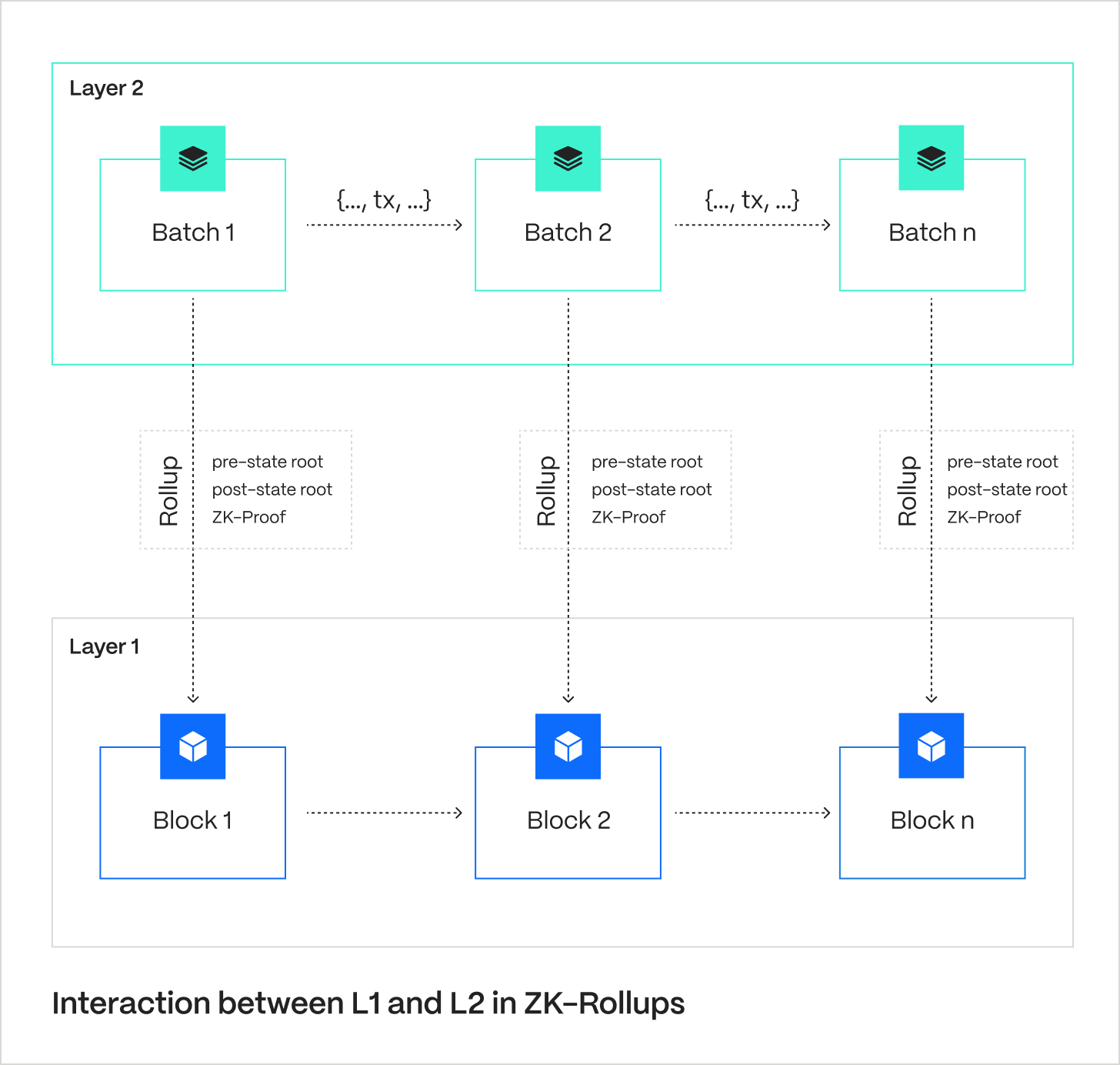
Optimistic rollups assume transactions are valid by default and use fraud proofs to catch errors after the fact. ZK rollups prove validity upfront using cryptographic proofs. This means ZK rollups finalize transactions as soon as the proof is verified on Ethereum, while optimistic rollups require a seven-day challenge window before funds are fully withdrawable.
Which is a ZK rollup L2?
A zero-knowledge rollup (ZK-rollup) is a Layer 2 scaling solution that executes transactions off the main layer 1 chain, such as Ethereum. Instead of sending raw transaction data, it submits a compact cryptographic proof to the L1 for verification. This approach significantly reduces gas costs and increases throughput compared to layer 1 execution.
Is zkSync built on Ethereum?
Yes, zkSync is an Ethereum Layer 2 network built by Matter Labs. It uses zero-knowledge proofs to batch transactions and post cryptographic validity proofs to the Ethereum mainnet. This integration allows zkSync to inherit Ethereum's security while providing faster and cheaper transactions for users.
No comments yet. Be the first to share your thoughts!