
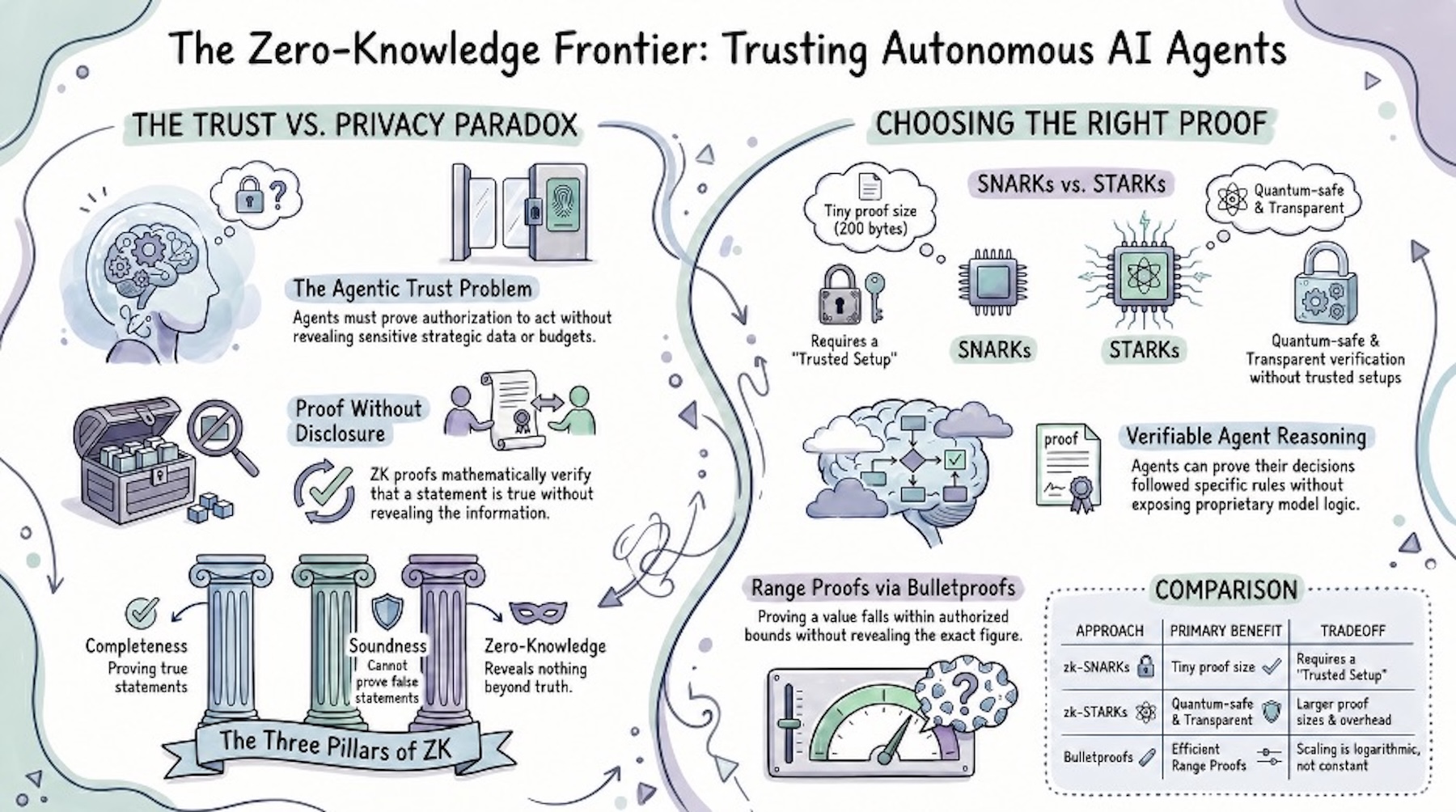
Defining the 2026 privacy standard
Zero-knowledge proofs (ZKPs) have moved from cryptographic curiosity to a foundational layer of digital infrastructure. In 2026, the definition remains precise: a method that allows one party to prove to another that a statement is true without revealing any information beyond the validity of the statement itself ethereum.org/zero-knowledge-proofs/. This distinction separates ZKPs from traditional verification, where access to data is often required to confirm its authenticity.
The transition in 2026 is defined by standardization. Early implementations were fragmented, often relying on custom, unverified code that posed significant security risks. The current landscape is governed by rigorous protocols established by bodies like ZKProof, which mandate formal verification and security audits. This shift ensures that ZKPs are no longer experimental but are compliant, auditable, and ready for high-stakes financial and regulatory environments.
Key Takeaway: ZKPs allow verification without data exposure, a critical shift for 2026 compliance.
For institutions, this means privacy is no longer a trade-off for transparency. Data can be verified for compliance—such as knowing a user is over a certain age or that a transaction is within limits—without exposing the underlying personal or financial details. This capability is becoming the baseline for secure, private data verification in regulated markets.
Comparing ZK Hub Architectures
The infrastructure supporting zero-knowledge proofs 2026 is splitting into two distinct camps: decentralized, open standards and centralized, proprietary implementations. This divergence defines the trade-off between verifiable trust and operational speed. Decentralized hubs, such as those governed by the ZKProof initiative, prioritize community-driven academic rigor and open-source transparency. In contrast, centralized hubs, often embedded within specific blockchain ecosystems or enterprise platforms, optimize for throughput and regulatory alignment.
The choice between these models dictates the risk profile for any application. Decentralized standards offer a "trustless" verification layer where the protocol's integrity is maintained by a broad network of auditors and developers. However, this openness can introduce latency in standard adoption and implementation complexity. Centralized hubs, while faster to deploy, concentrate trust in a single entity, creating a potential single point of failure or regulatory bottleneck.
The table below outlines the core differences in trust models, verification speed, and compliance capabilities between these two architectural approaches.
| Architecture | Trust Model | Verification Speed | Regulatory Compliance |
|---|---|---|---|
| Decentralized (e.g., ZKProof) | Community-driven, open-source | Variable, often slower due to consensus | Flexible, requires custom integration |
| Centralized (e.g., Enterprise Hubs) | Single-entity, proprietary | High, optimized for throughput | Built-in, easier for audits |
| Hybrid | Partial decentralization | Balanced | Moderate complexity |
For developers building in 2026, the decision often hinges on the specific use case. Financial applications requiring strict audit trails may favor centralized hubs for their ease of compliance, while public goods and open finance protocols will likely rely on decentralized standards to maintain user sovereignty. As the landscape matures, hybrid models are emerging to balance these competing demands.
zk-Rollups and scaling privacy
Zero-knowledge proofs 2026 are no longer just theoretical cryptography; they are the engine behind the most significant scaling solutions in blockchain. zk-Rollups bundle hundreds of transactions into a single cryptographic proof, which is then submitted to the main Ethereum chain. This approach allows Layer 2 networks to process transactions at high speeds and low costs while maintaining the security guarantees of the base layer.
The privacy advantage is distinct. Unlike standard rollups that merely compress data, zk-Rollups can verify the validity of transactions without exposing the underlying details to the public ledger. As defined by ethereum.org, a zero-knowledge proof is a way of proving the validity of a statement without revealing the statement itself. This means users can transact with full confidentiality, knowing that only the network knows the truth of the transaction, not the world.
This architecture solves the "scalability trilemma" by prioritizing throughput without sacrificing decentralization. By offloading the computational heavy lifting to the ZK circuit, the main chain only needs to verify the proof, a process that is computationally cheap. The result is a system that scales linearly with demand while keeping data private and secure.
The adoption of zk-Rollups is driving the practical utility of ZKPs in 2026. Major protocols are shifting from optimistic rollups to zero-knowledge variants because they offer finality without the delay of challenge periods. This shift is critical for financial applications where speed and privacy are non-negotiable. As the ecosystem matures, the ability to verify complex state transitions privately will become the standard for high-value on-chain activity.
Identity and age assurance use cases
Zero-knowledge proofs 2026 are moving beyond abstract cryptographic experiments into concrete regulatory compliance, particularly in identity verification. As digital services face stricter data protection mandates, the ability to prove attributes without revealing underlying data has become a technical necessity rather than a luxury. This shift is most visible in age assurance and proof-of-humanity protocols, where traditional identity sharing poses unacceptable privacy risks.
The European Union’s eIDAS 2 Regulation, set to take full effect in 2026, is a primary driver of this adoption. The framework requires robust digital identity solutions that respect user privacy while ensuring legal compliance. In this context, zero-knowledge proofs allow users to demonstrate they meet specific criteria—such as being over a certain age or holding a valid license—without exposing their actual birthdate or personal details. Google has already begun opening its ZKP libraries for age assurance, signaling that major tech infrastructure is aligning with these new regulatory standards.
Proof-of-humanity applications face similar challenges. In an era of synthetic media and bot-driven manipulation, verifying that a digital participant is a unique human being is critical for governance and security. ZKPs enable systems to confirm human presence or uniqueness without collecting biometric data, which reduces the attack surface for identity theft. This approach redefines digital privacy by replacing data sharing with proof-based verification, ensuring that identity systems remain secure even as threats evolve.
The transition to ZK-based identity verification is not just about technology; it is about rebuilding trust. By decoupling verification from data exposure, organizations can comply with emerging regulations while protecting user autonomy. This balance between regulatory requirement and individual privacy is the defining characteristic of identity systems in 2026.
Choosing a zero-knowledge proofs 2026 implementation strategy
Selecting a ZK architecture is no longer a binary choice between privacy and performance. By 2026, the landscape has bifurcated into distinct pathways based on whether the priority is verifiable compliance or absolute data concealment. Developers must map their specific threat models against the computational overhead of proof generation.
On-chain verification for compliance
For enterprises requiring regulatory transparency, on-chain verification remains the gold standard. This approach involves deploying a verifier contract that validates proofs directly within the blockchain state. While this incurs higher gas costs and limits proof complexity, it ensures that the integrity of the transaction is cryptographically guaranteed by the network itself. This is ideal for financial audits where the proof itself must be publicly accessible and immutable.
Off-chain generation for scalability
When privacy is paramount, off-chain generation offers superior scalability. Here, proofs are generated in a trusted setup or using post-quantum resistant schemes, then only the succinct proof and verification key are submitted on-chain. This allows for complex computations, such as full transaction history validation, without bloating the blockchain. The ZKProof initiative continues to standardize these circuits to ensure interoperability across different L2 rollups and privacy-preserving applications.
Hybrid models for enterprise adoption
The most robust 2026 strategy often employs a hybrid model. Sensitive data remains off-chain in secure enclaves, while zero-knowledge proofs anchor the data's validity on-chain. This balances the need for private data handling with the public auditability required by financial institutions. As the technology matures, the gap between proof generation time and verification cost continues to narrow, making this hybrid approach increasingly viable for high-frequency trading and private banking systems.
No comments yet. Be the first to share your thoughts!