
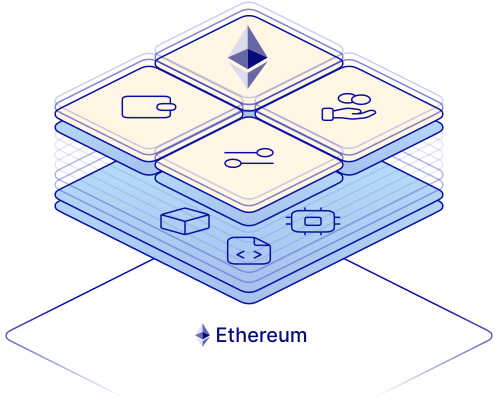
ZK Hubs redefine blockchain privacy
Zero-knowledge proofs (ZKPs) have long been defined as a method for proving the validity of a statement without revealing the statement itself [ethereum.org]. For years, these cryptographic tools operated in isolation, embedded within single applications or specific layer-2 solutions. The 2026 landscape marks a structural shift from these siloed implementations to interconnected ZK Hubs. These hubs aggregate proofs across multiple chains, creating a unified infrastructure for privacy-preserving transactions at scale.
This transition moves beyond simple transaction verification. ZK Hubs serve as central clearinghouses for cryptographic integrity, allowing different blockchain ecosystems to communicate securely without exposing underlying data. By standardizing how proofs are generated and verified, these hubs reduce the computational overhead that previously limited widespread adoption. The result is a more cohesive network where privacy is not an afterthought but a foundational layer.
The implications for market structure are significant. As ZK Hubs mature, they enable complex financial instruments that require both transparency and confidentiality. This duality is critical for institutional adoption, where regulatory compliance must coexist with competitive secrecy. The technology is evolving from a niche cryptographic curiosity into a core component of the decentralized financial stack, driven by the need for scalable, private infrastructure.
ZK-Rollups drive adoption metrics
Zero-knowledge rollups (ZK-Rollups) have shifted from experimental prototypes to the dominant scalability layer for Ethereum. By batching hundreds of transactions off-chain and submitting a single validity proof to the mainnet, they offer the highest throughput among current Layer 2 solutions. Unlike optimistic rollups, which rely on fraud proofs and require a seven-day challenge period, ZK-Rollups provide cryptographic finality almost instantly. This efficiency makes them the preferred choice for high-frequency applications, including decentralized exchanges and gaming platforms that demand low latency.
The market reality reflects this technical superiority. ZK-Rollups now process the majority of Layer 2 transaction volume, driven by protocols like zkSync, StarkNet, and Scroll. As the ecosystem matures, the focus has shifted from raw speed to the "ZK Hub" narrative: a centralized or semi-centralized settlement layer that aggregates multiple ZK-rollups, allowing them to interoperate while inheriting Ethereum’s security. This hub-and-spoke model reduces redundancy and lowers costs for users who need to move assets between different ZK chains.
To understand the current landscape, it helps to compare the core metrics of the leading ZK-Rollup implementations. The table below outlines the differences in throughput, finality, and security models for the primary contenders in the 2026 market.
| Protocol | Throughput (TPS) | Finality Time | Security Model |
|---|---|---|---|
| zkSync Era | ~2,000 | ~10-30 mins | STARK-based validity proofs |
| StarkNet | ~3,000+ | ~10-30 mins | STARK-based validity proofs |
| Scroll | ~4,000 | ~10-30 mins | SNARK-based validity proofs |
| Linea | ~2,500 | ~10-30 mins | SNARK-based validity proofs |
The choice between SNARK and STARK-based systems often comes down to hardware requirements and proof generation speed. SNARKs are faster to generate but require a trusted setup, while STARKs are quantum-resistant and trustless but more computationally intensive. As hardware accelerates, this gap is narrowing, allowing both models to coexist in the ZK Hub ecosystem. For real-time market context, the performance of these rollups often correlates with broader Ethereum network activity.
ZK Hubs for Identity and Age Assurance
The shift toward ZK identity systems moves beyond simple authentication to solving complex regulatory compliance. In 2026, the European Union’s eIDAS 2.0 regulation creates a new mandate for digital identity wallets, requiring services to verify user attributes without exposing underlying personal data. Zero-knowledge proofs provide the cryptographic foundation for this shift, allowing a prover to convince a verifier that a statement is true without revealing the data itself.
ZK hubs function as the central verification layer in this architecture. Instead of a service provider asking for a full ID card scan, the user interacts with a ZK hub to generate a proof that they meet specific criteria, such as being over 18 or residing in a certain jurisdiction. The hub validates the credential against the issuer and returns a compact proof. The verifier checks this proof, confirming compliance without ever seeing the user’s birthdate or government ID number.
This approach is particularly critical for age assurance in digital spaces. Google has released open-source ZK libraries specifically to support age verification, enabling platforms to confirm a user is of legal age without storing sensitive biometric or personal information. By decoupling the verification of age from the storage of identity data, ZK hubs reduce the attack surface for data breaches and align with privacy-by-design principles.
The technology transforms regulatory compliance from a burden into a privacy feature. Users gain control over their data, while service providers meet strict legal requirements. As eIDAS 2.0 takes effect, ZK hubs will likely become the standard infrastructure for digital identity, ensuring that privacy and compliance can coexist.
Comparing ZK scalability solutions
Zero-knowledge (ZK) proofs enable verification of information such as identity, balance, or transaction validity without revealing underlying data ZKProof. As the ecosystem matures, three primary architectures have emerged: ZK Rollups, ZK Sidechains, and ZK Hubs. Understanding the tradeoffs between cost, speed, and privacy is essential for selecting the right infrastructure.
ZK Rollups vs. Sidechains vs. Hubs
ZK Rollups batch transactions off-chain and post compressed proofs to the main chain, offering the highest security but higher computational costs. ZK Sidechains operate independently with their own consensus, providing faster finality but relying on a separate validator set. ZK Hubs coordinate proof aggregation from multiple sources, balancing scalability with shared security.
| Feature | ZK Rollups | ZK Sidechains | ZK Hubs |
|---|---|---|---|
| Security Model | Inherits L1 security | Independent validator set | Shared hub security |
| Transaction Cost | High (proof generation) | Low | Moderate |
| Finality Speed | Slow (proof verification) | Fast | Variable |
| Privacy Level | High (optional) | Low (public) | High (aggregated) |
Choosing the Right Architecture
The decision depends on your specific use case. For high-value financial transactions where security is paramount, ZK Rollups are the standard. For high-throughput applications like gaming or social media, ZK Sidechains offer the necessary speed. ZK Hubs are emerging as the preferred solution for cross-chain interoperability, allowing different networks to communicate securely.
| Feature | ZK Rollups | ZK Sidechains | ZK Hubs |
|---|---|---|---|
| Security | High | Medium | High |
| Cost | High | Low | Moderate |
| Speed | Slow | Fast | Variable |
Market Context
The adoption of these solutions is reflected in the broader crypto market. Investors are increasingly looking at projects that implement ZK technology for scalability and privacy.
FAQ: Zero-Knowledge Proofs 2026
Is zero-knowledge proof the future?
Zero-knowledge proofs are becoming an essential technology for safe and secure future societies that require a high level of privacy. As digital infrastructure matures, these proofs will likely underpin the trust layers for everything from financial settlements to identity verification, moving from niche cryptography to standard web protocols.
How do ZK Hubs impact scalability?
ZK Hubs serve as centralized aggregation points for proof verification, significantly reducing the computational load on individual blockchain nodes. By batching and verifying proofs off-chain before submitting a single succinct proof to the mainnet, these hubs allow networks to process thousands of transactions per second without congesting the base layer.
What are the main types of zero-knowledge proofs?
The two most common types are zk-SNARKs and zk-STARKs. zk-SNARKs are smaller and faster but often require a trusted setup, while zk-STARKs are quantum-resistant and do not need a trusted setup, though they produce larger proofs. The choice depends on whether you prioritize speed and size or long-term security and transparency.
No comments yet. Be the first to share your thoughts!